Paper, studied properly: what a canvas made of HTML actually buys your agent
The design tool an agent can write to is no longer a category of one. What Paper's HTML canvas really changes, and what the head-to-head found.

Our first four studies looked at tools that draw a screen from a sentence. This week, the surface underneath them. Paper is a design tool whose canvas is real HTML and CSS, and the interesting part is not what it draws. It is the door it leaves open for your agent. A five-minute read.
📐 The Study: Paper
What it actually is. Paper is a code-native design tool, on the web and as a macOS desktop app, where a frame is a div and a style is CSS, not a proprietary file format. The piece that matters here is its MCP server. Open a file in Paper Desktop and the server starts on your own machine; connect Cursor, Claude Code, Codex or Copilot, and an agent is working inside your design file. Paper's documentation lists twenty-one tools: eleven read the file, among them get_jsx and get_computed_styles; the rest create artboards, write HTML, update styles, duplicate, move and delete.
The pitch that no longer holds. Paper is usually sold as the canvas an agent can write to, unlike Figma. That was true; it is not any more. Figma's own MCP documentation now says plainly: "Write to the canvas: Create and modify native Figma content directly from your MCP client." What is left of the difference is the medium. A model writing into Paper writes the web directly. A model writing into Figma writes through a translation layer, and reads back through one too.
Where it fits in a real workflow. Picture a two-person studio building a client landing page. Select the hero frame, ask the agent to build it in React and Tailwind in an empty folder, then point it at your other frames as breakpoints; Paper's docs walk that loop end to end, warning that the bigger the frame, the more the agent gets wrong. The reverse direction is the less obvious half. With a Notion server connected alongside Paper's, select a testimonial block of placeholder text, tell the agent to sync it with the real Notion database, then ask for a German version to see whether the layout survives longer words. An afternoon of copy-paste, gone.
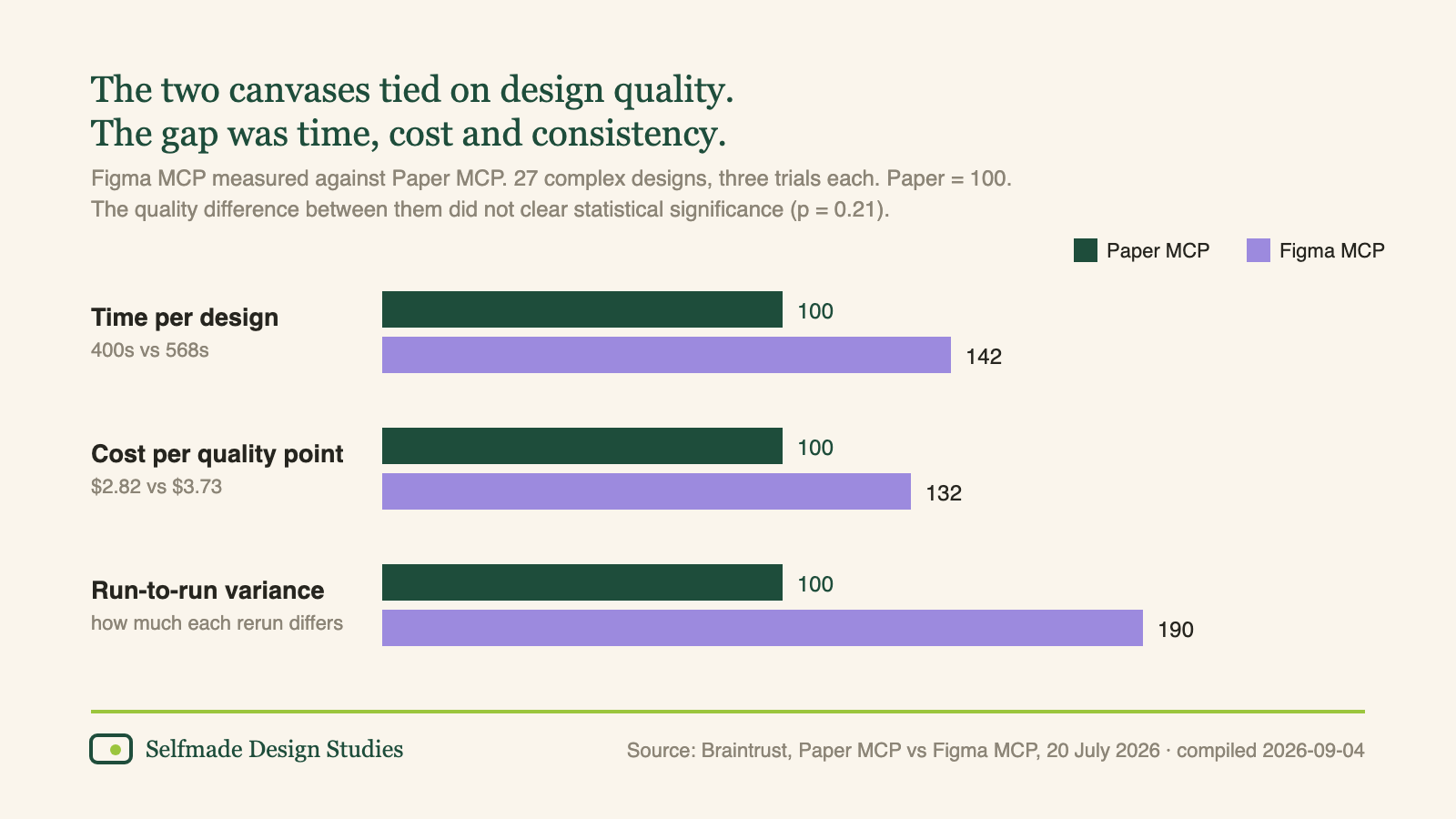
What the evidence says. The eval company Braintrust ran the two servers head to head in July, having agents rebuild designs as self-contained HTML: forty simple pages, then twenty-seven complex ones at three trials each. On quality they tied, "the paired difference does not clear significance (p = 0.21)". The measurable gaps were operational.
Where it falls short. Three limits, one of them awkward for the pitch. The markup, first. In the same evaluation, "Figma uses semantic tags at over 3 times Paper's rate. Paper's output is 46% <div>s to Figma's 35%." For a tool whose argument is that the canvas is already the web, that is the finding to sit with: you still owe the markup a human pass. Second, the design-system half is unfinished. August's build log shipped tokens created in the app rather than only through MCP, but the public roadmap still lists themes and tokens, native Tailwind, code components and vector editing as in progress, and CSS Grid as merely planned. Third, the meter and the session. The free tier allows a hundred MCP tool calls a week; Pro is $20 per editor per month, $16 billed yearly. The docs' own troubleshooting note is the one you meet first: "the most common cause of issues is really long running agent sessions."
Who should care. Design engineers already living in Cursor or Claude Code: the strongest case, because the write direction closes a seam no plugin was going to close. Product designers inside a Figma organisation: not a migration, a second canvas for agent work, since your own server writes now too. Non-designer founders: the least hand-holding of the five tools we have studied, though a hundred calls a week disappears in an evening. Disclosure: this newsletter's brand assets are built in Paper.
🗞️ The Digest
- Figma's shaders start moving, and outside agents can edit them. The September 1 release note makes generated shaders animated and reactive to the mouse, opens Community publishing for generative plugins, adds a code viewer, and updates MCP so third-party agents can modify them. On September 3, opacity became something you alias on a colour variable instead of detaching from the library by hand.
- Midjourney moves editing into the lightbox. The September 2 alpha changelog puts the V8.2 edit model inside the image lightbox: edit by plain instruction, attach up to four reference images, see a session's edits in one place. A Change Style experiment sits beside it, and the edit model got a quality patch on August 29.
- Framer's agent learns depth. On September 1, "Framer's Agent now supports all 3D Transform properties like Rotate XYZ, Perspective, Origin, Depth, Backface, and many more," with the layers still editable on canvas afterwards.
- Runway's agents get the workflow list. Runway's August 20 changelog adds workflow support to its MCP server, so an agent can list the workflows in your workspace and open one in the web app. This week's Study, one industry over.
- Krea's model shelf turns over again. Krea's release notes record Veo 2 and Veo 3 sunset on August 28, Reve's image models switched off on August 31, Alibaba's Wan 3.0 arriving the same week, and a Krea plugin going live inside ChatGPT on September 1. If a client deliverable depends on one named model at one price, that belongs in the quote.
Fifth study in the series; the earlier ones on DESIGN.md and Midjourney V8.2 are on the site. Have you let an agent write into a design file, or do you keep it read-only on purpose? Reply and tell us what it broke, or what it saved you.
Forwarded this by a friend? Subscribe here. Found it useful? Forward it to one person who'd want it.
— The Editorial Team