Midjourney V8.2, studied properly: bolder by default, and an editor finally in testing
Midjourney's third V8 step this year. What the bolder default gives a working designer, what still routes through V7, and the editor that arrived yesterday.

Read time: ~5 minutes.
Our first three studies were tools that draw interfaces from a sentence. This week, the image model most designers still measure the others against. Midjourney's V8.2 has been the default for five weeks, and yesterday the company opened testing of its first V8 editing model. What does the current version actually give a working designer?
📐 The Study: Midjourney V8.2
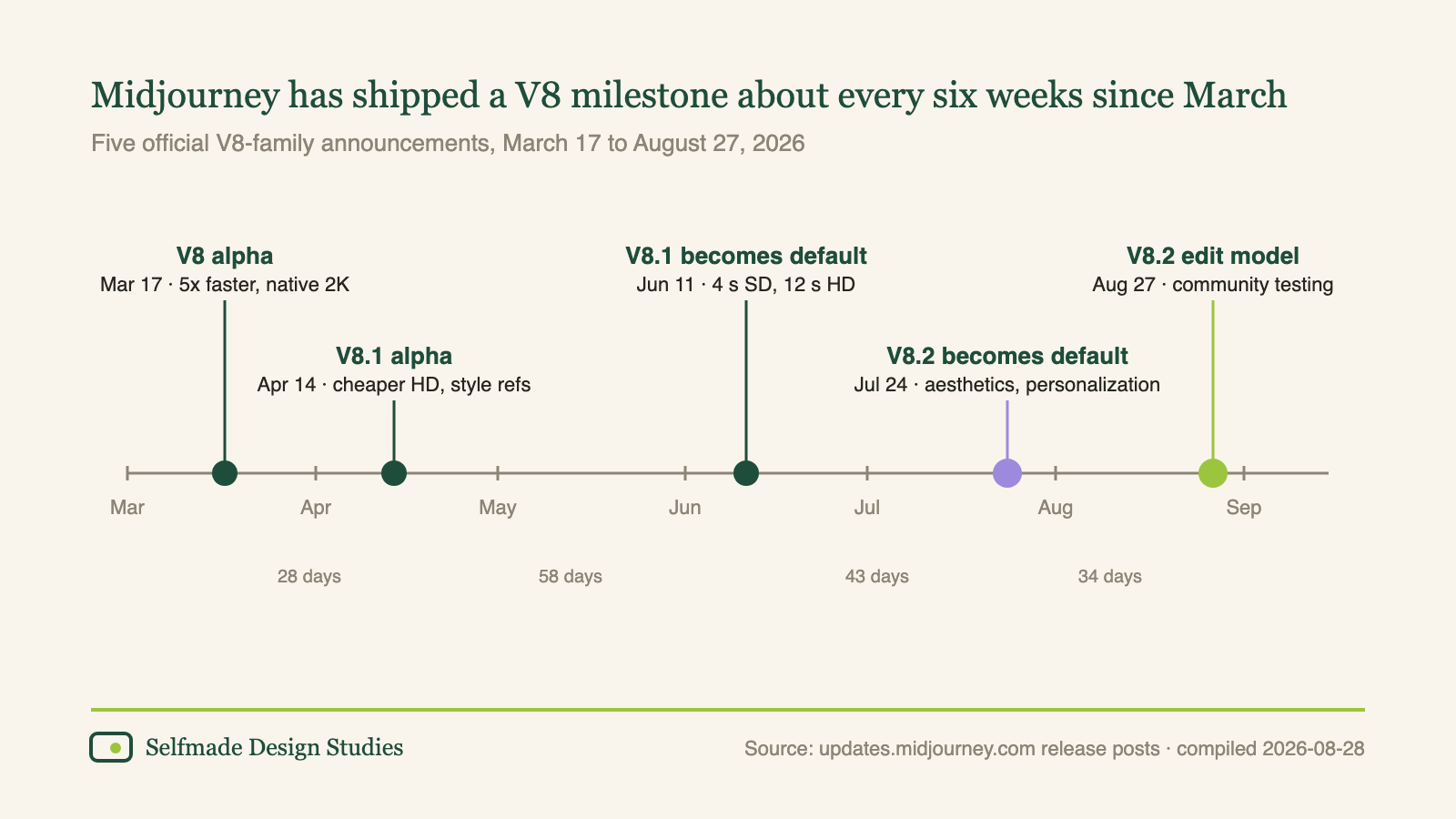
What it actually is. V8.2 is the third public step of Midjourney's V8 family, and the company's release posts tell the story cleanly. The V8 alpha arrived on March 17 with two structural changes: "Image generation is ~5x faster than before," and a new --hd mode that "natively renders images at 2K resolution." V8.1 became the default on June 11, with images appearing "in only 4 seconds in SD, and 12 seconds in HD." Then on July 24 V8.2 took over, an update the company frames around aesthetics, image quality and personalization: "Images should be more creative, bold, sophisticated, edgy and fresh," and "Random situations where you'd get a low quality image should be dramatically reduced." Personalization profiles, which tune the model to images you have rated, now draw from "a much larger and improved pool of images." Yesterday, August 27, the company began letting everyone test its first V8.2 edit model: editing by instruction, inpainting and outpainting, and generation from up to four reference images at once.
Where it fits in a real workflow. Picture a brand builder producing a campaign key visual with no photographer budget. The V8 loop has three gears. First, exploration in Draft mode, which returns 24 low-resolution images for half the usual fast-hours cost, and, since June, accepts --sref random to spray those 24 across different styles. Second, the real generation in V8.2 with a personalization profile on, where the model starts to look like your taste rather than the internet's average. Third, --hd for the 2K deliverable. PixMind's migration guide adds the discipline: generate with personalization off first, enable profiles one at a time, and "Preserve a V8.1 baseline." Their line on the new default is the one to pin up: "A bolder default may help a key visual and hurt a plain product reference." When it hurts, --raw pulls the styling back.
Where it falls short. Four limits, one of them a courtroom:
- The V8 family is still not the whole tool. Blake Crosley's 8.2 guide, updated August 18, lists what V8.2 does not support: Character Reference, multi-prompts, the quality parameter, Niji models and Turbo mode. Omni Reference, which carries a subject's face and clothing between images, "routes through V7," so you get V7's look for exactly the shots where consistency matters most. Until this week, editing meant leaving V8 entirely: Run the Prompts noted in late July that the editor still ran on V6.1. Yesterday's edit model is the answer, and Midjourney calls it a test: "There's gonna be a lot of edge cases here," and personalization, moodboards and style references "may work best with some extra prompt direction in this version."
- The improvement is real and modest. Run the Prompts ran identical prompts through V8.1 and V8.2 and found better shadows, richer reflections and fewer weak images per batch, with differences "not dramatic." Their verdict: "V8.2 is better than V8.1, but it does little to answer the growing concern that Midjourney is losing the AI image battle."
- Type is still not the model's job. AI Worth It's review, updated August 18, puts it plainly: "V8 improved text rendering significantly, but it's still not reliable enough for images that depend on accurate typography." Set your headline in your own tool. The same review notes there is still no free tier.
- The legal overhang has not moved. Disney, Universal and Warner Bros. are suing Midjourney over training and outputs. The Art Newspaper reported that a mid-June ruling denied Midjourney's request to see how the studios themselves use AI, and that Midjourney filed a motion for review on June 29. The case is pending. For client work, that is a disclosure conversation, not a reason to stop; we explain, we do not advise.
Who should care. Brand builders: yes; a personalization profile trained on your taste is the closest thing to a house style the model offers. Product designers: useful for moodboards and hero imagery, with the V7 detour and the typography rule in mind. Non-designer founders: a first-try image now looks finished sooner, which is exactly when to check whether it looks like your brand or like Midjourney.
🗞️ The Digest
- Recraft makes style a reusable object. Recraft V4 Styles (Aug 26) builds a style from one reference image, sharpened by up to ten more, with a "Precise" mode that locks technique, color, composition and lighting and a "Flexible" mode that keeps only the mood. "Style it once, every image matches" is the problem Midjourney's personalization attacks from the other side: taste as a saved setting, not a prompt.
- Figma's agent gets its own window. Figma's August release notes add a detachable agent chat panel on the desktop app (Aug 26), direct erase and recolor tools for vectors (Aug 24), centrally managed MCP authorization for Enterprise and Organization admins (Aug 24), and two new auto-layout spacing options, "Around" and "Evenly" (Aug 21). The admin item is the quiet one: agent access is now IT policy, not a consent click.
- Firefly's studio adds sound and a free door. Adobe's August 20 announcement makes Generate Music, Speech and Sound Effects generally available, adds Google's Gemini Omni Flash to the partner-model roster, and opens a free tier of daily generations for the Firefly AI Assistant.
- Thirty-second clips in one pass. Seedance 2.5 landed in Recraft Studio (Aug 17), generating "up to 30 seconds in a single pass" at 18 credits for 480p or 41 for 720p, so a product moment plays out instead of looping.
Fourth study in the series; the earlier ones on Claude Design and DESIGN.md are on the site. Have you trained a V8.2 personalization profile, or tried the new edit model in its first day? Reply with what it got right and what needed extra prompt direction. We are collecting the misses for a follow-up.
Forwarded this by a friend? Subscribe here. Found it useful? Forward it to one person who'd want it.
— The Editorial Team